
Apart from skin cancer, breast cancer is the most common cancer among women in the United States. Knowing what raises your risk, when screening is recommended, and how a diagnosis is confirmed can help you have more informed conversations with your healthcare provider.
What Raises Breast Cancer Risk?
A risk factor increases the chance of developing a disease. It does not mean you will get breast cancer. Many people who are diagnosed have no known risk factors other than getting older.
Risk factors you cannot change include:
- Getting older
- Inherited gene changes, such as in the BRCA1 or BRCA2 genes
- A family history of breast or ovarian cancer
- A personal history of breast cancer or certain noncancerous breast conditions
- Dense breast tissue
- Starting menstrual periods early or reaching menopause late
- Radiation therapy to the chest before age 30
Risk factors you may be able to influence include:
- Physical inactivity
- Overweight or obesity after menopause
- Drinking alcohol
- Certain hormone therapies taken during menopause
- Reproductive factors, such as having a first pregnancy after age 30 or not breastfeeding
When Should Screening Start?
Screening looks for cancer before any symptoms appear, when it is often easier to treat. Mammograms are the main screening test.
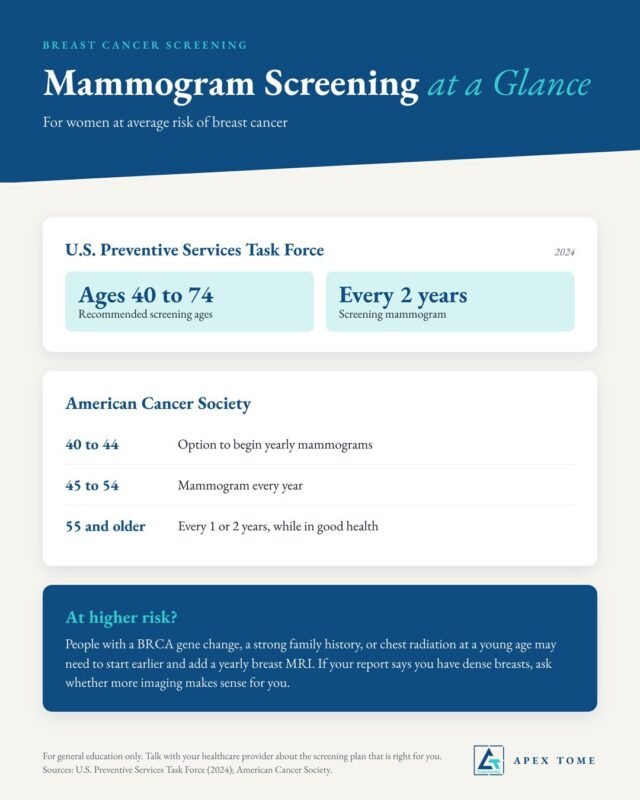
The U.S. Preventive Services Task Force recommends a mammogram every two years for women ages 40 to 74 who are at average risk. The American Cancer Society recommends yearly mammograms from ages 45 to 54, with the option to start at 40. From age 55, it recommends a mammogram every one or two years.
Because these recommendations differ slightly, talk with your provider about which schedule fits you. People at higher risk may need to start earlier and add a yearly breast MRI. This includes people with a BRCA gene change or a strong family history. If your mammogram report says you have dense breasts, ask whether additional imaging makes sense for you.
How Is Breast Cancer Diagnosed?
If a mammogram shows something unusual, or if you notice a breast change, the next step is usually more imaging. This may include a diagnostic mammogram, an ultrasound, or sometimes an MRI. Being called back for more tests is common, and most additional testing does not find cancer.
Only a biopsy can confirm a diagnosis. In this procedure, a small sample of tissue is removed, usually with a needle, and examined under a microscope. The resulting pathology report describes the cancer’s type, its grade, and whether it has hormone receptors or the HER2 protein. These details help guide treatment.
If you notice a new breast change, do not wait for your next scheduled mammogram. Contact your healthcare provider to have it checked.
If you or someone you love has recently been diagnosed, our guide Newly Diagnosed with Breast Cancer explains pathology reports, staging, subtypes, and treatment options in plain language.
