
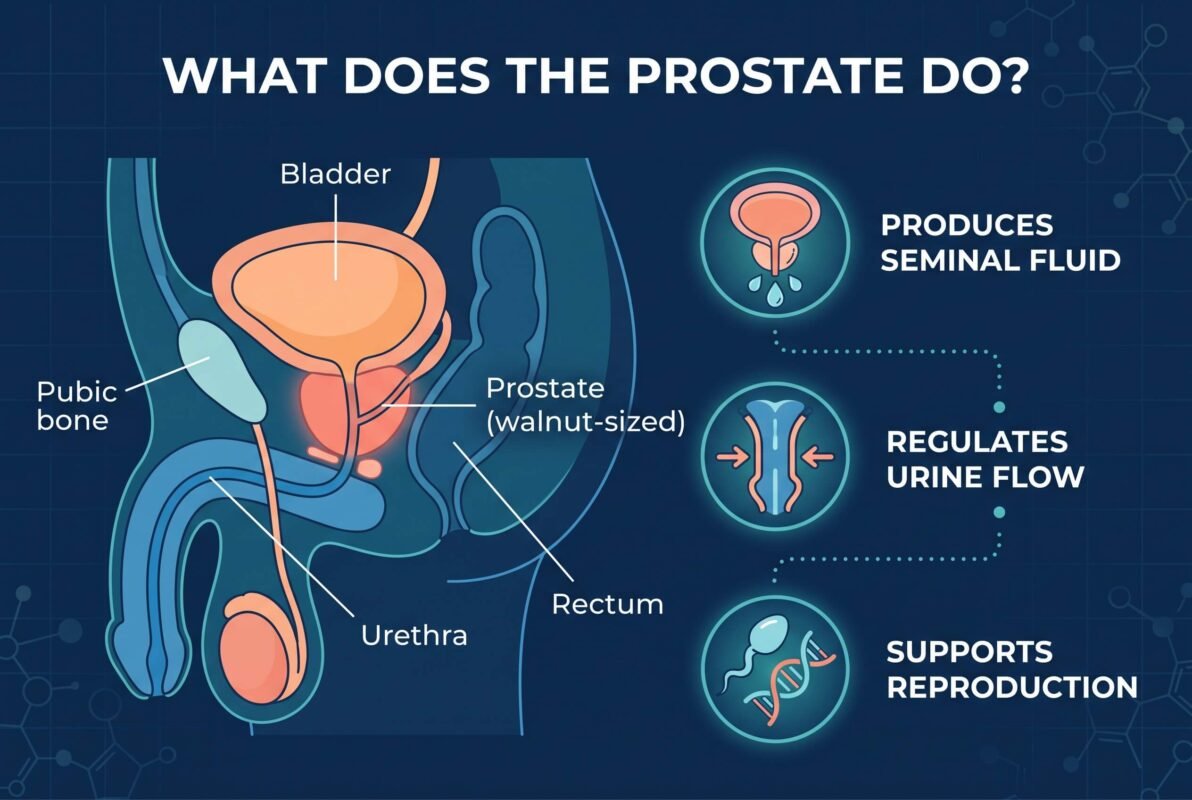
If you have ever left a checkup wondering what the prostate actually is, you are not alone. Many men first hear about it when a doctor mentions a PSA test, or when nighttime bathroom trips start to add up. The short answer: the prostate is a small gland that makes part of the fluid in semen. Because it sits right below the bladder and wraps around the tube that carries urine out of the body, changes in the prostate often show up as changes in urination. This article explains what the prostate does, where it is, how it changes with age, and which symptoms are worth bringing to a healthcare professional.
Where the Prostate Is and What It Looks Like
The prostate is a gland in the male reproductive system. The National Cancer Institute describes it as sitting just below the bladder and in front of the rectum, the last section of the large intestine. It is often compared to a walnut or a chestnut in size and shape.
Its location matters as much as its function. The prostate surrounds the upper part of the urethra, the tube that carries urine from the bladder out through the penis. In men, the urethra also carries semen during ejaculation. As the National Institute of Diabetes and Digestive and Kidney Diseases (NIDDK) explains, both urine and semen pass through the prostate on their way out of the body.
That arrangement explains why a gland with a reproductive job is so often linked to urinary symptoms.
What the Prostate Does
The prostate has one main job: it makes fluid that becomes part of semen. Semen is the mixture of sperm, which are made in the testicles, and fluids from the prostate and nearby glands called the seminal vesicles.
Prostate fluid supports reproduction in a few ways:
- It helps carry sperm. The fluid adds volume to semen so sperm can travel out of the body during ejaculation.
- It helps protect and nourish sperm. Substances in prostate fluid help sperm survive and move.
- It contains PSA. Prostate-specific antigen (PSA) is a protein made by the prostate. Small amounts enter the bloodstream, which is why PSA can be measured with a blood test.
Muscle tissue in the prostate also helps push semen into the urethra during ejaculation.
The prostate is not required to stay alive. It is important for fertility, though, and NIDDK notes that prostate fluid plays a role in a man’s ability to father children. The prostate does not make sperm, and it does not make testosterone. Testosterone, the main male hormone, comes mostly from the testicles, but the prostate depends on it to grow and work.
How the Prostate Changes With Age
The prostate does not stay the same size throughout life. It grows during puberty, and in many men it begins to grow again later in adulthood. Doctors do not know exactly why. NIDDK points to aging, changes in male hormone levels, inflammation, and fibrosis (extra tissue that becomes thick and stiff) as possible contributors.
Because the prostate wraps around the urethra, a larger gland can squeeze that tube and make it harder for urine to flow. This is why prostate changes are so often noticed in the bathroom first.
Growth with age is common, and it is not the same thing as cancer. Still, new urinary symptoms deserve a conversation with a healthcare professional instead of a guess.
Common Prostate Problems
NIDDK lists three common prostate problems. They are different conditions with different causes, even though some symptoms overlap.
Prostatitis is inflammation, or swelling, of the prostate. It can affect men of any age and is the most common prostate problem in men younger than 50. Some cases are caused by bacteria. In chronic prostatitis, which is long-lasting, doctors often do not find an infection.
Benign prostatic hyperplasia (BPH) is an enlarged prostate that is not caused by cancer. “Benign” means noncancerous, and “hyperplasia” means an increase in the number of cells. BPH is the most common prostate problem in men older than 50. Symptoms are rare before age 40 and become more common with age.
Prostate cancer develops when cells in the prostate grow out of control. Early prostate cancer often causes no symptoms at all. The risk factors with the strongest evidence, according to the U.S. Preventive Services Task Force, are older age, African American race, and a family history of prostate cancer.
You can read more about each of these in our ENLARGED PROSTATE (BPH) Guide and [INTERNAL LINK: PROSTATITIS ARTICLE].
Symptoms That May Point to a Prostate Problem
Many prostate symptoms involve urination and bladder control. NIDDK describes symptoms such as:
- Needing to urinate often, including waking at night to urinate
- A sudden, urgent need to urinate
- Trouble starting a urine stream, or a weak or interrupted stream
- Dribbling at the end of urination
- Feeling that the bladder has not fully emptied
- Pain while urinating or after ejaculation
- Pain in the lower belly, lower back, penis, scrotum, or the area between the scrotum and anus
These symptoms do not point to one specific condition. A urinary tract infection, bladder problems, diabetes, and some medications can cause similar changes. Symptoms alone cannot tell you which prostate problem, if any, is present. That takes an evaluation.
How Doctors Check the Prostate
An evaluation usually starts with questions about your symptoms, your medical history, and your family history. From there, a healthcare professional may use one or more of these tools:
- Digital rectal exam (DRE). The clinician inserts a gloved, lubricated finger into the rectum to feel the size and condition of the prostate.
- Urine tests. These can look for signs of infection.
- PSA blood test. A higher PSA level can be a sign of prostate cancer, but the test is not perfect. PSA can also rise with BPH or prostatitis, and many men with a high PSA do not have cancer.
- Ultrasound or other imaging. Images can show the size and shape of the prostate.
- Urodynamic tests and cystoscopy. These check how well the bladder and urethra hold and release urine, or let the doctor look inside them with a thin scope.
- Prostate biopsy. Small tissue samples are examined under a microscope. A biopsy is how prostate cancer is diagnosed.
Screening is a separate question from testing because of symptoms. Screening means testing men who feel well. The U.S. Preventive Services Task Force currently says that for men ages 55 to 69, PSA screening should be an individual decision made after discussing the possible benefits and harms with a clinician. It recommends against routine PSA screening for men 70 and older. That recommendation dates from 2018 and is being updated, and other medical groups offer somewhat different guidance, so it is worth asking your own clinician what applies to you. Our [INTERNAL LINK: PSA TEST GUIDE] covers the test in more detail.
When to Contact a Healthcare Professional
Most prostate symptoms are not emergencies, but they should not be ignored either. The level of urgency depends on what you are experiencing.
Schedule a routine visit if you notice ongoing changes such as:
- A weak urine stream, or trouble starting or keeping a stream
- Urinating eight or more times a day, or waking often at night to urinate
- Dribbling, urgency, or a feeling of incomplete emptying
- Pain during urination or after ejaculation
Seek prompt medical attention if you have:
- Blood in your urine
- Fever, chills, or body aches along with urinary symptoms
- Significant pain in your belly, pelvis, or genital area
Get medical help right away if you cannot urinate at all. NIDDK notes that this can happen suddenly, sometimes after taking certain cold or allergy medicines, and it needs immediate care. Urgent or emergency care is also appropriate for a high fever with shaking chills and an inability to pass urine.
It can help to bring a few questions to your appointment:
- What could be causing my symptoms?
- Which tests do you recommend, and what will they show?
- Could any of my current medications be affecting my bladder or prostate?
- Given my age and family history, should we talk about PSA screening?
Can You Keep Your Prostate Healthy?
It is natural to look for a way to prevent prostate problems, and many products claim to offer one. The evidence is more modest. NIDDK states that researchers have not found ways to prevent prostate problems, and have not found that eating, diet, and nutrition play a role in causing or preventing them.
What is in your control is awareness. Knowing what the prostate does, recognizing urinary changes early, and talking openly with a healthcare professional can help problems get identified and treated sooner. General healthy habits support overall health, even though they are not a proven way to prevent prostate conditions. Be cautious with supplements marketed for prostate health, and talk with a healthcare professional or pharmacist before starting one, since supplements can interact with medications.
For more reading on related topics, visit the [INTERNAL LINK: APEX TOME MEN’S HEALTH CATEGORY].
Learn More
Understanding what the prostate does is a helpful first step toward making sense of symptoms, test results, and conversations with your doctor. For a more detailed explanation of symptoms, testing, treatment options, and questions to discuss with your healthcare team, explore Prostate Health Handbook from Apex Tome. The handbook covers PSA testing, BPH, and screening decisions in greater depth, in plain language you can review at your own pace.
This article is for general education only and is not a substitute for personalized advice, diagnosis, or treatment from a qualified healthcare professional.
